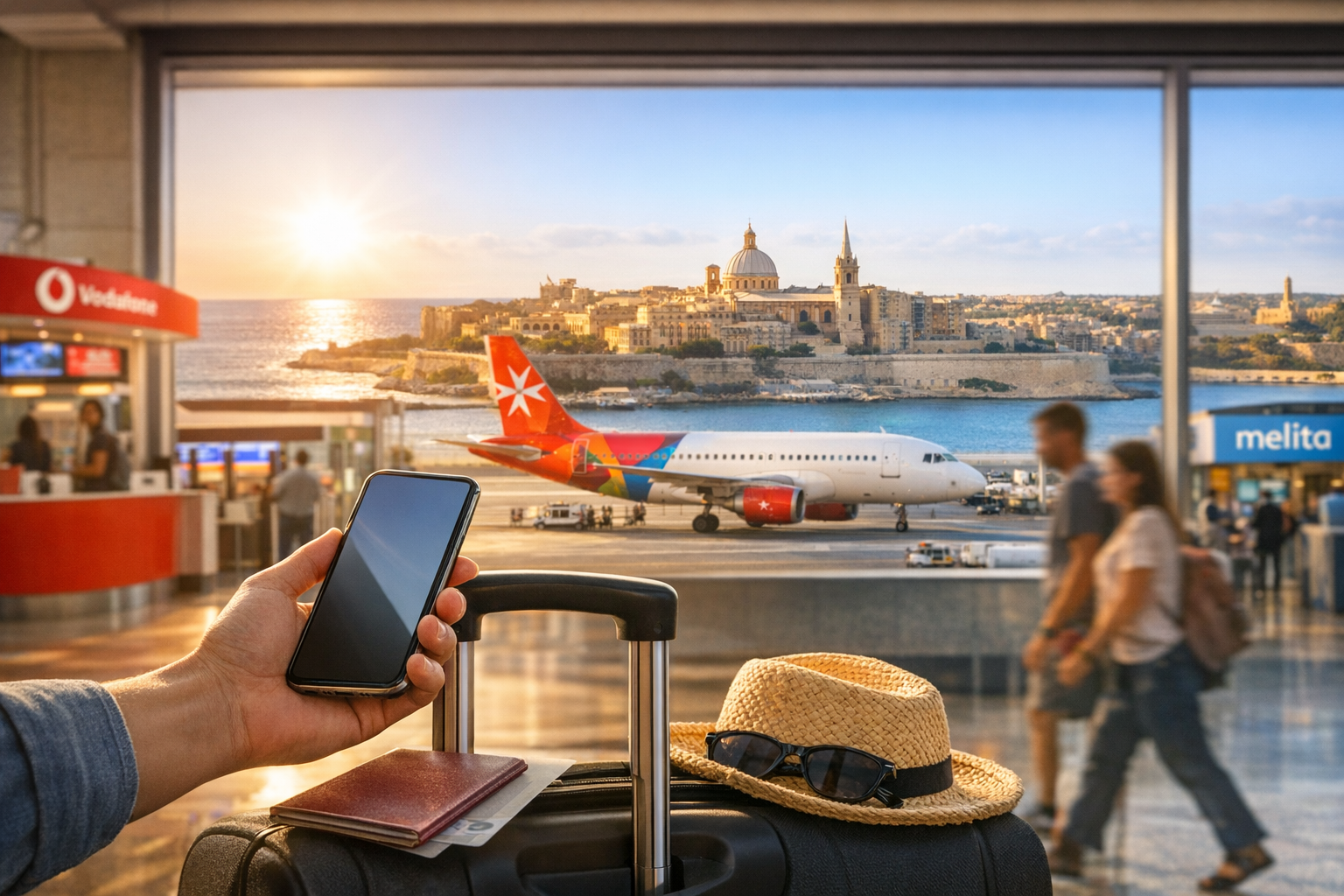
SIM card at Malta airport: what’s available, what you need, and what to do if you land late
Arriving in Malta without mobile data can turn an exciting trip into a stressful start. Even a short delay in getting connected can cause problems, whether that is struggling to book transport, find your accommodation, or reassure family that you have landed safely.
Malta may be compact, but it is a modern, digital‑first destination. Many everyday travel tasks rely on mobile data, from booking Bolt rides to checking ferry times, accessing digital hotel check‑ins, or navigating narrow historic streets.
This guide is designed to remove uncertainty. It explains exactly what to expect when buying a SIM card at Malta International Airport, what you will need, what it usually costs, and what to do if your flight lands late at night when airport SIM desks may be closed.
It also explores alternatives that many travellers now prefer, including eSIMs, and helps you decide which option is right for your trip.
By the end, you will know how to stay connected in Malta confidently, without queues, confusion, or last‑minute compromises.
Why mobile data matters from the moment you land in Malta
For many travellers, Malta feels familiar. English is widely spoken, the island is easy to navigate, and distances are short. That familiarity can make it tempting to assume you can sort connectivity later.
In practice, mobile data is useful almost immediately.
Most travellers rely on their phone for:
Booking a Bolt or checking bus routes from the airport
Navigating to hotels in Valletta, Sliema, St Julian’s, Mellieha or Gozo
Accessing booking confirmations and digital room keys
Messaging hosts on Airbnb or Booking.com
Checking ferry schedules, restaurant hours, and attraction tickets
Using maps in areas with complex one‑way systems
Airport Wi‑Fi can help for a few minutes, but it is rarely reliable enough for everything you need to do on arrival. Once you leave the terminal, you are fully dependent on mobile data.
That is why planning how you will get connected in Malta is as important as booking flights or accommodation.
Explore options for staying online from the moment you land by visiting the travel eSIM Malta plans.
Can you buy a SIM card at Malta International Airport?
Yes, you can buy a SIM card at Malta International Airport (MLA), but it is not guaranteed in every arrival scenario.
SIM cards are sold inside the terminal, usually in the arrivals area after passport control. They are offered by Malta’s main mobile networks through staffed kiosks or retail counters.
Whether you can buy one depends on several factors:
The time your flight lands
Whether staff are on duty
How busy the terminal is
Seasonal demand
If you land during daytime hours, buying a SIM card at the airport is usually possible. If you land late in the evening or early in the morning, options may be limited or unavailable.
This timing issue is the single biggest reason travellers struggle to get connected at Malta airport.
Understanding Malta’s mobile networks
Malta has three main mobile network operators. All provide good coverage across the island, including cities, resorts, and most rural areas.
GO
GO is one of Malta’s largest telecommunications providers. It offers prepaid SIM cards and tourist bundles aimed at short‑term visitors, typically including generous data allowances.
Melita
Melita is well known locally for strong coverage and competitive prepaid plans. It also offers tourist SIM options, often marketed at visitors arriving by air.
Epic
Epic is Malta’s third main network and provides prepaid SIM cards with data bundles suitable for tourists and short stays.
In terms of signal quality, all three networks perform well across Malta. The difference at the airport is not coverage, but availability, pricing, and opening hours.
Where SIM cards are sold at Malta airport
SIM cards are usually sold from:
Mobile network kiosks or branded counters
Small retail outlets in the arrivals area
These are staffed locations, not vending machines. A member of staff will normally:
Ask for your passport or ID
Register the SIM
Activate it for you
Sometimes help install it in your phone
This can be helpful if you are unfamiliar with SIM setup, but it also means queues can form, especially when several flights arrive close together.
Opening hours: the biggest limitation of airport SIMs
SIM desks at Malta airport do not operate 24 hours a day.
Opening hours vary, but generally follow standard retail patterns. This means:
Good availability during the day
Reduced coverage in the evening
Limited or no service late at night
Many flights from the UK and Europe arrive in Malta in the evening. If your flight lands after normal retail hours, you should assume there is a real chance you will not be able to buy a SIM card at the airport.
This is where many travellers get caught out.
What documents do you need to buy a SIM in Malta?
To buy a physical SIM card in Malta, you will usually need:
A passport or valid photo ID
A phone that is unlocked
The staff will register your details as part of the purchase. This is a standard requirement in many countries and helps comply with local regulations.
If you do not have your passport with you, or if your phone is locked to a specific carrier, you may not be able to complete the purchase.
How much does a SIM card at Malta airport cost?
Airport SIM cards are priced for convenience rather than value.
Although prices change, travellers should expect:
Higher prices than buying in town
Tourist‑focused bundles designed for short stays
Fewer plan choices compared to city shops
If you are staying in Malta for more than a few days, or if you want flexibility, airport SIMs are rarely the best value option.
They are convenient when they work, but not always cost‑effective.
Why late arrivals struggle with airport SIMs
Late arrivals are one of the most common problem scenarios.
If your flight lands late at night, you may find:
SIM counters closed
No staff available
Long queues if a desk is open but understaffed
At that point, you are forced to rely on airport Wi‑Fi or wait until the next day to get connected.
For travellers heading straight to accommodation, this can mean navigating unfamiliar streets or transport systems without reliable data.
What to do if you land late at night in Malta
If you know your flight lands late, it is best to plan for the possibility that you will not be able to buy a SIM at the airport.
Your options are:
Use airport Wi‑Fi temporarily
Wait until the next day and buy a SIM in town
Set up mobile data before you fly
For most travellers, the third option is the least stressful.
Why many travellers now choose an eSIM instead
An eSIM allows you to set up mobile data before you travel, without visiting a shop or inserting a physical SIM card.
Instead, you download your data plan digitally using a QR code or app. Once installed, your phone connects automatically to local networks when you arrive in Malta.
This avoids:
Queues at the airport
Opening hour restrictions
Paperwork and ID checks
The risk of landing without data
For travellers arriving late, or those who simply want a smoother arrival, an eSIM is often the easiest solution.
What exactly is an eSIM?
An eSIM is a built‑in digital SIM already inside your phone.
Instead of swapping plastic cards, you:
Buy a data plan online
Download it to your phone
Activate it when you arrive
Most modern smartphones support eSIM, including many iPhones, Samsung Galaxy models, and Google Pixel devices.
Once activated, an eSIM works just like a physical SIM for mobile data.
Will an eSIM work properly in Malta?
Yes. Malta has excellent mobile infrastructure, and eSIMs connect to local partner networks automatically.
You can expect reliable data in:
Valletta and the Three Cities
Sliema, St Julian’s and Paceville
Mellieha, Bugibba and St Paul’s Bay
Gozo and Comino
Major beaches and tourist attractions
For most travellers, performance is comparable to a local SIM card.
Keeping your UK number while using an eSIM
One of the biggest advantages of an eSIM is dual SIM functionality.
Most modern phones allow you to:
Keep your UK SIM active for calls and texts
Use your travel eSIM for mobile data
This is ideal for:
Receiving bank verification codes
Keeping WhatsApp and iMessage linked to your number
Staying reachable without roaming charges
You do not need to give up your UK number to stay connected in Malta.
Physical SIM vs eSIM: a detailed comparison
Buying a SIM at Malta airport may suit you if:
You land during daytime hours
You want in‑person help setting up
You prefer a traditional physical SIM
Using an eSIM may suit you if:
You land late or early
You want data immediately on arrival
You want to avoid queues and paperwork
You are comfortable setting things up in advance
For most travellers, the convenience of an eSIM outweighs the familiarity of a physical SIM.
Buying a SIM card in Malta city centres
Some travellers choose to wait and buy a SIM card in town instead of at the airport.
This can offer:
Lower prices
More plan options
Better value for longer stays
However, this means spending your first hours in Malta without mobile data, which is not ideal for navigation or transport.
It can work, but it requires patience and planning.
Is airport Wi‑Fi enough to get by?
Airport Wi‑Fi is useful, but it has limitations:
Speeds fluctuate during busy periods
Connections can drop unexpectedly
Access ends as soon as you leave the terminal
It is fine for a quick message, but not a reliable substitute for mobile data.
Common mistakes travellers make when arriving in Malta
Assuming SIM desks are always open
They are not, especially late at night.
Waiting until arrival to plan connectivity
This leaves you with fewer options if something goes wrong.
Paying premium prices without checking alternatives
Airport convenience often comes at a cost.
Forgetting to check phone compatibility
A locked or incompatible phone can prevent SIM or eSIM use.
How to prepare your phone before travelling to Malta
Before you fly, take a few minutes to:
Check that your phone is unlocked
Confirm eSIM compatibility if you plan to use one
Install your eSIM while on home Wi‑Fi
Keep your primary SIM active for calls and texts
Doing this in advance avoids stress on arrival.
Mobile data usage tips while in Malta
Once connected, a few habits can help you manage data effectively:
Download offline maps for walking routes
Use Wi‑Fi at accommodation for large updates
Keep location services on only when needed
Monitor background app usage
Most travellers find Malta’s data needs modest due to the island’s size.
Exploring Malta with reliable data
With mobile data, exploring Malta becomes far easier.
You can:
Navigate historic streets without getting lost
Check real‑time ferry updates to Gozo
Find quiet beaches and local restaurants
Book last‑minute tours and activities
Share photos and stay in touch
Connectivity removes friction and lets you focus on enjoying the trip.
Final verdict: should you buy a SIM card at Malta airport?
Buying a SIM card at Malta airport can work, but it is not always the best option.
Choose an airport SIM if:
You land during the day
You want face‑to‑face assistance
You are comfortable paying a premium
Choose an eSIM if:
You land late or early
You want data immediately
You prefer convenience and certainty
For most travellers, an eSIM provides the smoothest start to a Malta trip.
Stay connected in Malta without queues or stress
If you want mobile data working the moment you land, without worrying about opening hours or queues, setting up an eSIM before you travel is the simplest option.
Get connected quickly and easily by exploring the travel eSIM Malta plans and setting up your plan in minutes.
Related Articles

Travelling from Mexico to Europe? The simplest way to stay connected across Spain, France and Italy
Travelling from Mexico to Europe? Learn how to stay connected across Spain, France and Italy with one simple Europe eSIM. No roaming surprises.

Bali for Digital Nomads: Canggu, Ubud & Beyond
Bali for digital nomads explained. Discover Canggu, Ubud and beyond, real costs, WiFi tips, remote work life and how to stay connected in Bali.
Top 10 Spring Holiday Destinations for 2026
Discover the top 10 spring holiday destinations for 2026, from cherry blossoms in Japan to European city breaks, plus tips to plan a smarter spring escape.